2021–2026
Martini.ai
$6M seed funding

Background
Over four years, I worked directly with Martini.ai's founder as the sole product designer, transforming a sophisticated machine-learning model into a comprehensive credit-intelligence platform. The founders had the ML technology and domain expertise to model corporate credit risk — what was missing was a product experience financial professionals could actually understand, trust, and use daily. I worked alongside a small engineering team to build that experience from the ground up.
During this evolution, Martini.ai raised a $6M seed round, expanded its intelligence to more than 3.5 million public and private companies, and later joined BlackRock.
Core problem
Credit decisions depended on fragmented information and manual monitoring
Evaluating private and illiquid companies was slow and incomplete — credit professionals pieced together spreadsheets, financial statements, market data, news, and internal tools. Assessing one company took time; monitoring hundreds was far harder.
Martini connected companies through peers, industries, supply chains, and news to estimate probability of default and credit spread. The design challenge was making those predictions explainable: what changed, why, how the company compared to peers, and what evidence backed the assessment.
How might we turn a complex credit-risk model into an explainable system that helps professionals evaluate one company, monitor hundreds, and act on emerging risk?
Approach
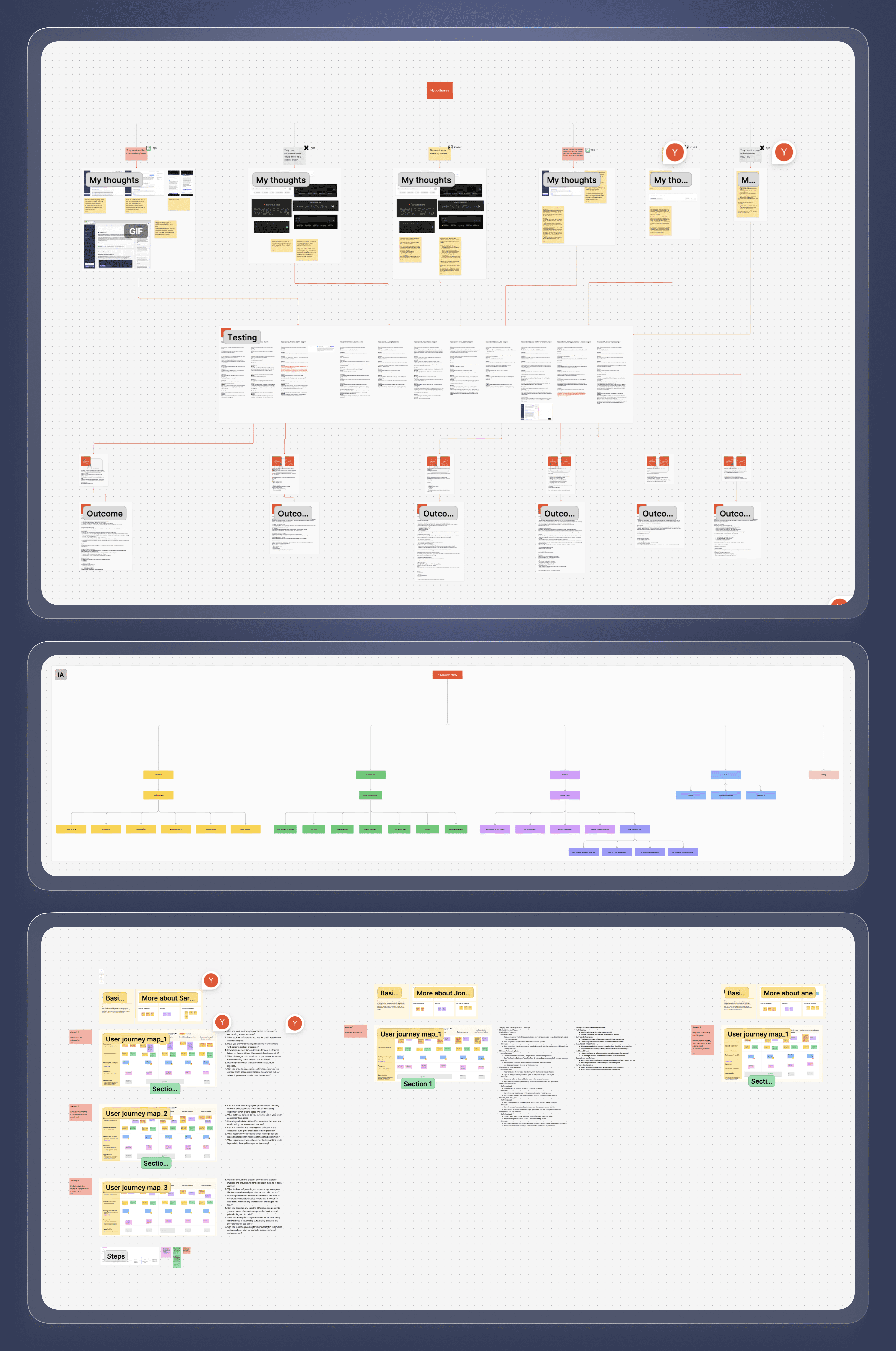
Martini evolved continuously rather than through one linear research cycle — weekly sessions with the founder, customer and prospect recordings, domain research, personas and journey maps, prototype testing, live-product feedback, and later Amplitude and Hotjar data.
It wasn't always clean. When the founder first described "portfolios," I pushed back before designing anything — the product only had separate company cards, with no real portfolio structure behind them. That kind of back-and-forth, sometimes waiting on backend feasibility before a feature's shape was settled, was normal throughout. The Scenario Builder, for instance, went through several rounds of "what's actually possible" before its scope locked.
The mature product served three institutional roles: private credit portfolio managers, CLO managers, and corporate counterparty risk managers. Over four years, it expanded from corporate-bond intelligence into four connected areas: company research, portfolio and sector monitoring, scenario testing, and AI-assisted workflows.
The platform
Much of what follows evolved from technical necessity and close founder-designer collaboration rather than upfront user research — the founders arrived with working ML technology and domain expertise, not a validated product direction. User feedback shaped refinement along the way, but the initial shape of most of these areas came from translating what the model could do into something professionals could use, not from a research phase that preceded design.
The platform had to support quick risk assessment and detailed investigation without hiding the professional depth users depended on.
A quick look at how these four areas connect in the live product
Company intelligence
The company page became the foundation of the platform. It needed to communicate the current risk assessment immediately while still giving professional users access to the depth behind it.
I structured the experience progressively. The first layer communicated the company's credit rating, outlook, coverage quality, and probability of default. Historical charts then showed whether risk was improving or deteriorating over time.
Users could continue into deeper analysis:
Credit spread and its historical movement
Term structure across different loan durations
Market and sector context
Comparable-company risk momentum
Comparable probability of default and net worth
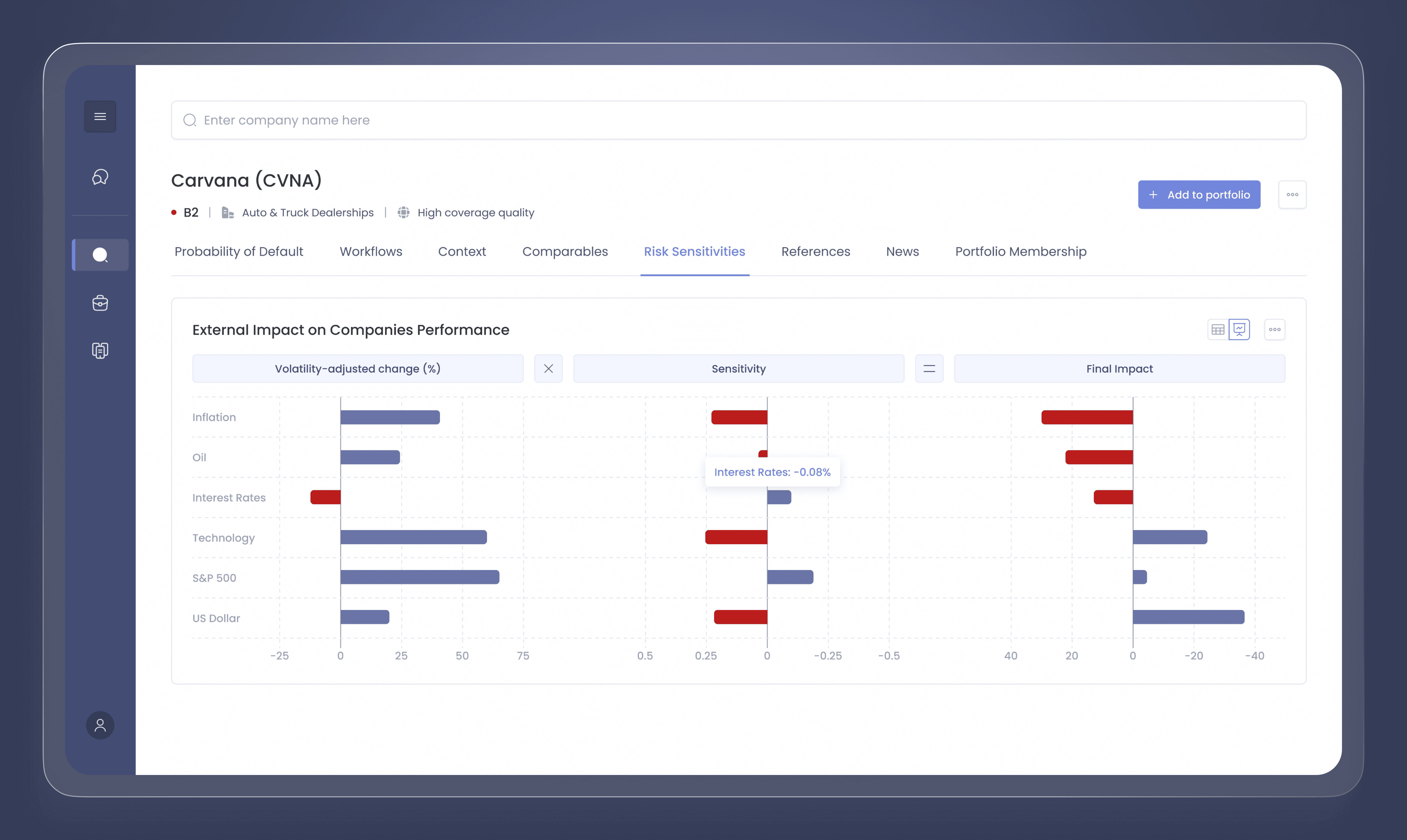
Sensitivity to inflation, interest rates, oil, technology, the S&P 500, and the U.S. dollar
Reference companies and their relevance to the calculation
Bonds and other company instruments
Related news and events


Portfolio and sector intelligence
Researching one company was only part of the workflow. Credit professionals needed to monitor potentially hundreds of holdings and understand where risk was developing across the portfolio.
I designed portfolio experiences that allowed users to create or import a portfolio and then monitor:
Number and value of holdings
Portfolio credit spread
Changes over time
Match rate and unmatched entries
Risk momentum
Top movers in probability of default
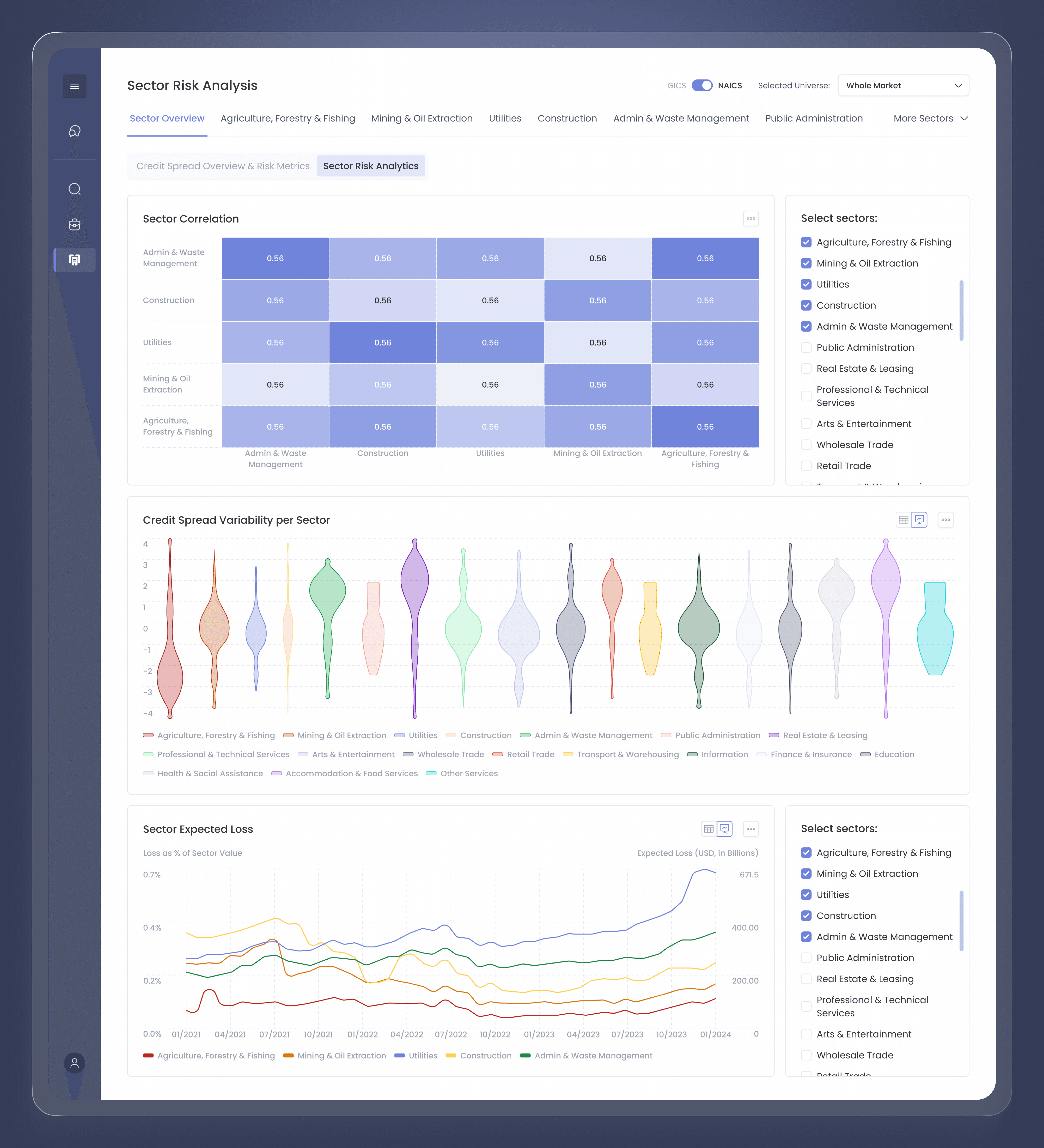
Sector distribution and concentration
Company and portfolio news
Alerts and emerging risk signals
The interface supported two levels of attention. At a glance, users could understand overall portfolio health and identify unusual movement. From there, they could investigate a sector, holding, or event without losing the wider portfolio context.
Sector intelligence added another layer between a single company and the full portfolio. Users could compare industries, follow broader risk movement, and understand whether a company's deterioration was isolated or part of a wider sector trend.
Together, company, sector, and portfolio views transformed Martini from a lookup tool into an ongoing monitoring system.

Scenario and stress testing
Traditional risk reporting is largely retrospective. Martini also needed to help professionals explore how future events could change the credit profile of a company or portfolio.
I designed risk-sensitivity views that connected probability of default to macroeconomic drivers such as inflation, interest rates, oil prices, technology indicators, the S&P 500, and the strength of the U.S. dollar.
The Scenario Builder expanded this into an interactive workflow. Users could describe a hypothetical event — such as an interest-rate shock, market decline, geopolitical conflict, or industry disruption — and refine the resulting macroeconomic assumptions.
Martini then translated those assumptions into projected changes across industries, companies, default risk, and expected loss. Users could compare the baseline with the stressed scenario, identify the most affected holdings, and understand where the portfolio was most vulnerable.
This shifted the experience from passively observing risk to actively preparing for it.

AI-assisted workflows
AI in Martini was never limited to a standalone chatbot. It became a way to access, interpret, and act on the product's existing credit intelligence.
I designed workflows for:
Generating company research
Finding comparable companies
Generating company and portfolio news
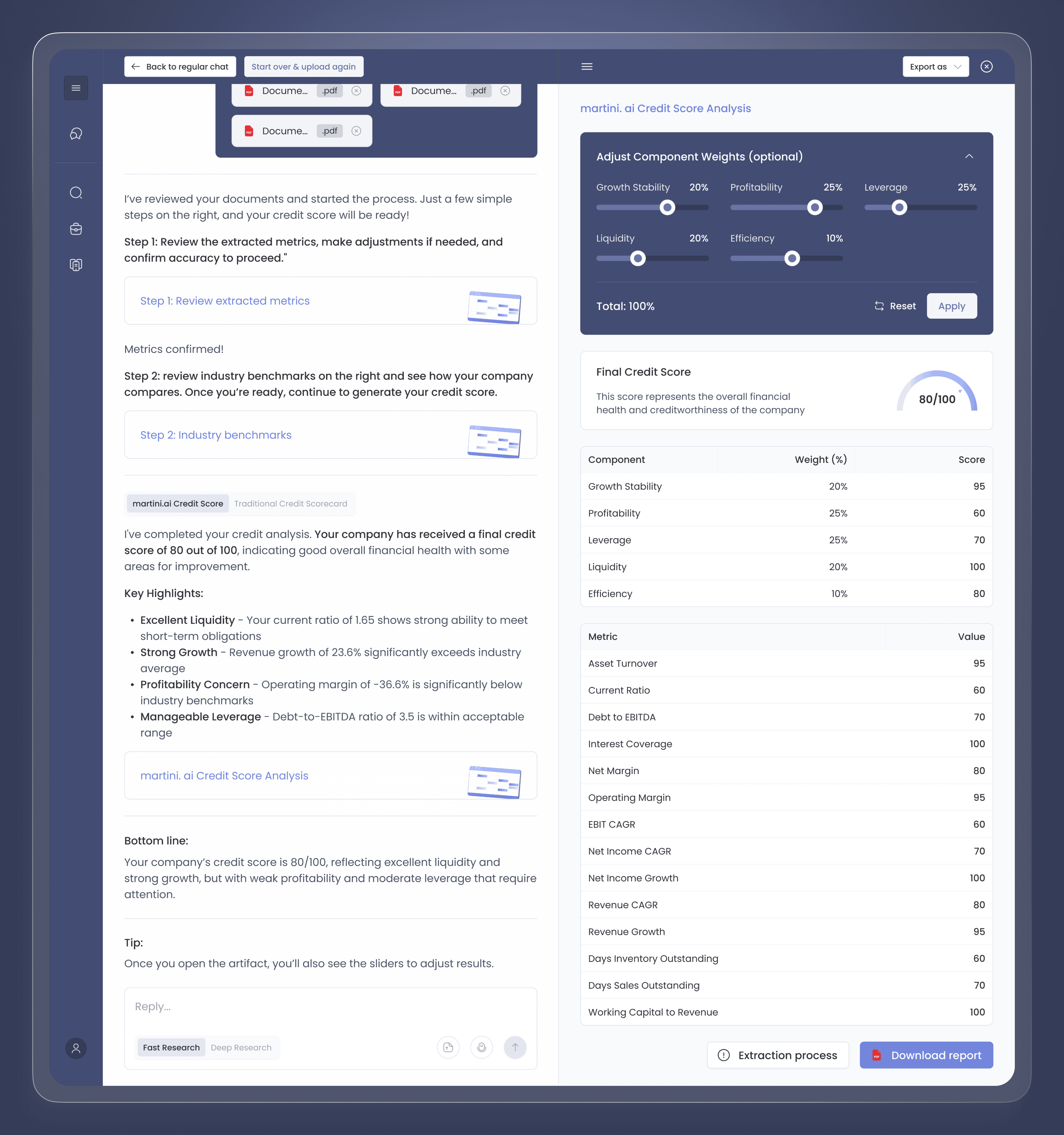
Uploading financial statements
Extracting financial information and producing credit analysis
Asking questions about uploaded documents
Generating downloadable Excel outputs
Running portfolio scenario tests
Producing trade ideas
Building editable reports
Exporting and sharing analysis
Focused improvement
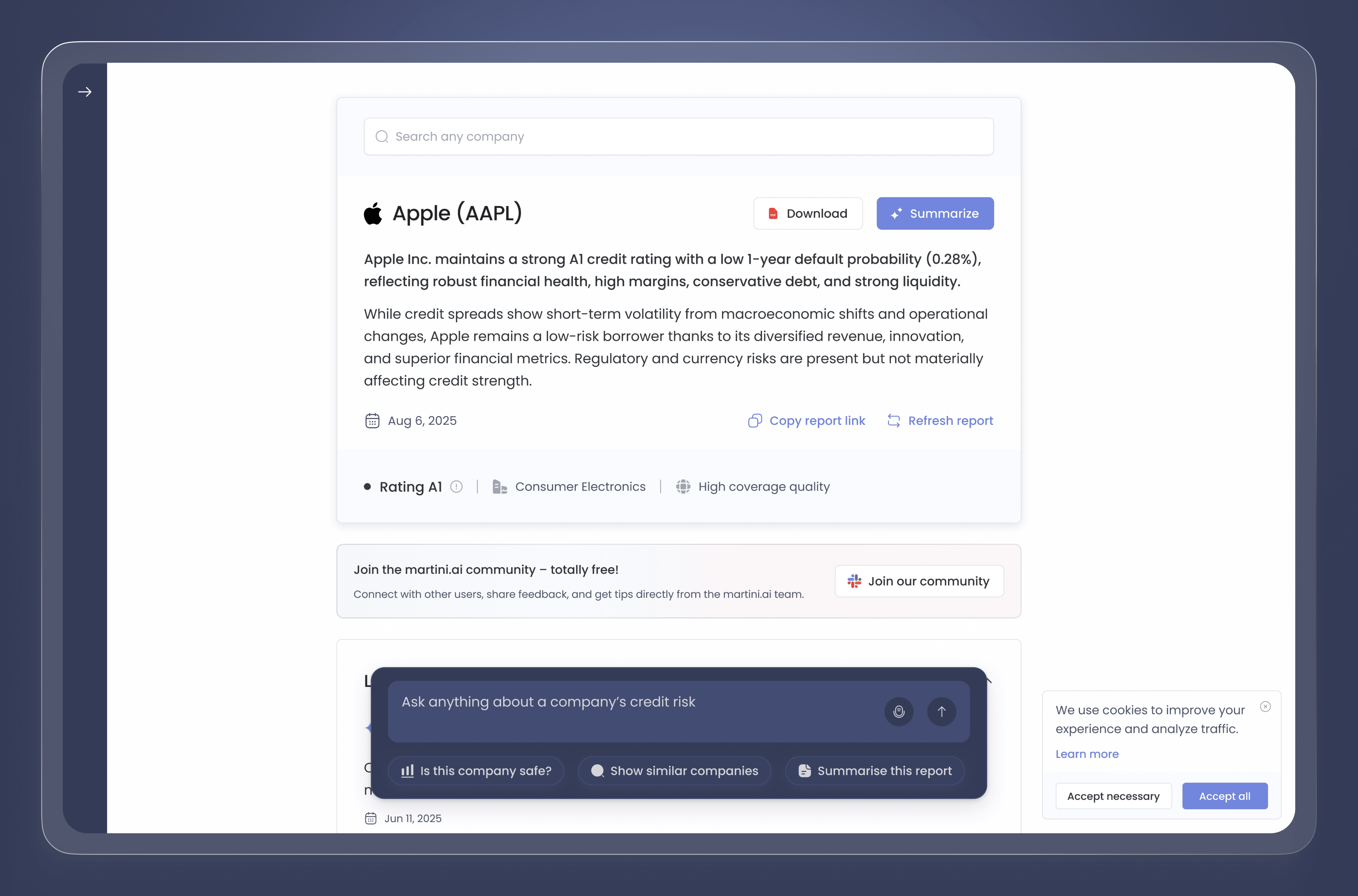
Martini also generated public company-report pages designed to bring organic search traffic into the product. Visitors could read a pre-generated credit report, download it, or continue the research through AI chat.
The pages attracted visitors, but very few started a conversation. I investigated the full report-to-chat journey to understand why. Amplitude showed that only 4 of 50 reviewed visitors started a chat, and just 2 stayed more than ten minutes. Two rounds of rapid testing — 12 participants, then 11, largely the same group — revealed why: people missed the low-contrast chat, the cookie banner covered its prompts, and the surrounding navigation competed for attention. Once users noticed the chat, they understood it — but only 2 of 12 typed a question without prompting.
I introduced a darker chat surface, clickable starter prompts, contextual "Explain with AI" actions, a clearer download CTA, and simpler navigation. I also moved the cookie banner, simplified the first response, and added clear paths back to the report and into follow-up questions.
Outcome
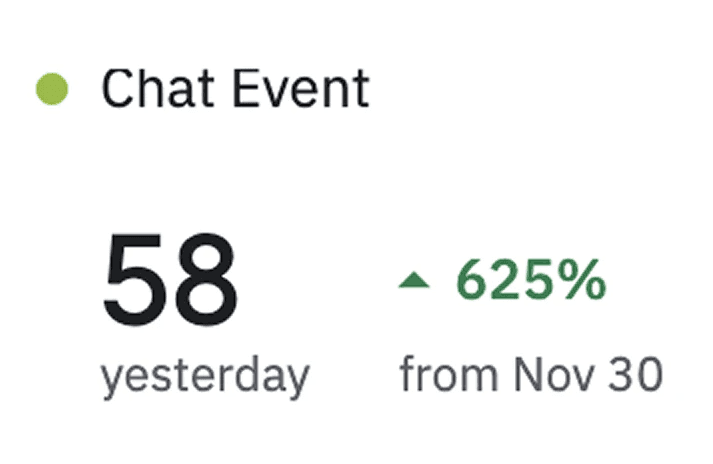
The improvement wasn't a single before-and-after — I tracked it as it happened. In the week the redesign started rolling out, chat sessions went from 2 to 14 to 35 across three consecutive weeks — more than doubling engagement even before every change was fully live. Amplitude confirmed a 112% increase from the pre-change baseline within days. After the full set of improvements went live, Amplitude showed a 625% increase in recorded chat events across the comparison period, and the founder separately confirmed that 80% of all chat engagement on the static pages was now coming from the AI CTAs I'd designed.
Hotjar recordings confirmed that the redesign was working: visitors scrolled further, spent more time with the report, and noticed the chat more consistently. With the discovery and comprehension barriers resolved, the experience created a stronger foundation for deeper AI engagement.
Results
Over four years, Martini.ai grew from an early corporate-credit model into a platform for company research, portfolio monitoring, scenario testing, and AI-assisted analysis.
The company raised a $6M seed round, expanded to more than 3.5 million public and private companies, and later joined BlackRock.
Reflection
Martini taught me that simplifying a professional product does not mean removing its depth; it means revealing that depth in the right order. My role was to connect scores, context, sources, portfolios, and AI workflows into one experience without pretending the underlying decisions were simple.